
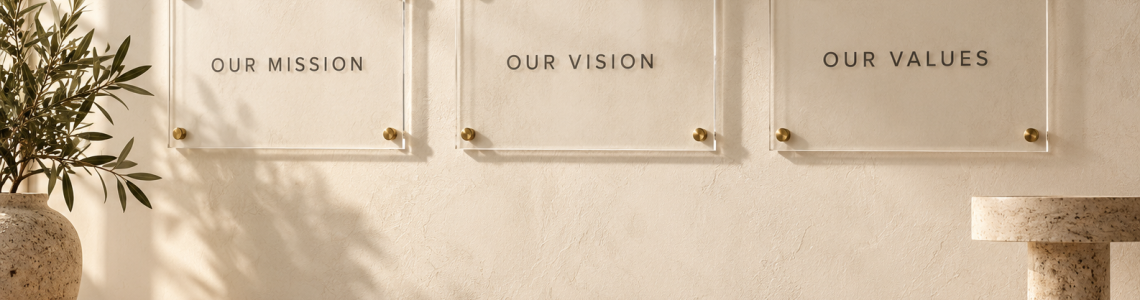
A culture wall in an office reaches people who visit that office. A hybrid team needs a plan for colleagues who encounter the company’s values through a screen, another location, or an onboarding document. The physical display can still be useful, but it should be one expression of a shared message rather than the only place that message exists.
The key buying decision is what belongs on the wall and what needs a maintained digital counterpart. Plan both before approving permanent wording.
Choose one authoritative source
Keep the approved mission, vision, and values in a source that the responsible team can maintain. Use that source for the wall and the digital version. This reduces the chance that a remote onboarding page and an office plaque gradually develop different wording.
Record any approved differences, such as a shorter wall statement linked to a fuller explanation. A concise version can be appropriate, but it should not become a separate unofficial interpretation of the company’s purpose.
Write for people outside the room
Avoid copy that depends on seeing a particular office, recognizing a mural, or knowing a local tradition unless that context is explained elsewhere. A phrase such as “the way we do things here” can be unclear when “here” includes several working environments.
Ask remote colleagues to review the wording for clarity, not merely to approve a photograph. They may identify assumptions that are invisible to the team designing the physical wall. Their feedback should inform the shared content rather than only the digital presentation.
Give the physical wall a specific job
The display might support in-person onboarding, team discussions, or visitor introductions. Choose one primary use and design for it. There is no need to imply that every employee will interact with the wall daily.
When colleagues gather in person, the display can provide a common reference during a discussion. The facilitator should still explain the values and invite questions. The presence of a plaque does not demonstrate that the team agrees on every interpretation or experiences the values consistently.
Make digital access straightforward
Provide the approved wording as readable text in the organization’s chosen resource. A photo can show the office context, but it should not be the sole information source. Check that intended employees can access the page from their normal working setup.
If the wall includes a link or QR code, identify the destination owner and provide a recognizable written route as well. Do not put private employee information on a publicly accessible page simply to make scanning easier. Access needs and content sensitivity should be reviewed together.
Maintain both versions after launch
Assign responsibility for updating the wall record and the digital resource when the approved message changes. Include translations and any onboarding materials that refer to the display. A shared update checklist is more dependable than hoping each team notices a new version.
Ask for feedback on whether people understand the message and know where to find it. Avoid claiming that a culture wall by itself improves remote engagement or team cohesion. Those outcomes depend on much more than visible wording.
Frequently asked questions
Does a hybrid team still need a physical values wall?
Only if it serves a useful in-person purpose. The decision should follow how the office is used, not an assumption that every company needs one.
Can we send employees a photograph instead?
A photo can add context, but provide the actual approved text in a usable digital format too.
Should the wall link to an internal or public page?
Choose according to the content and audience. Test permissions and avoid exposing internal material unintentionally.
Define the wall’s role
Explore the personalized mission-and-values plaque with a clear in-person use case and a separate plan for keeping the same message available to the whole team.
Cover image: AI-generated editorial visualization of three mission, vision and values plaques; not a photograph of a customer installation.