
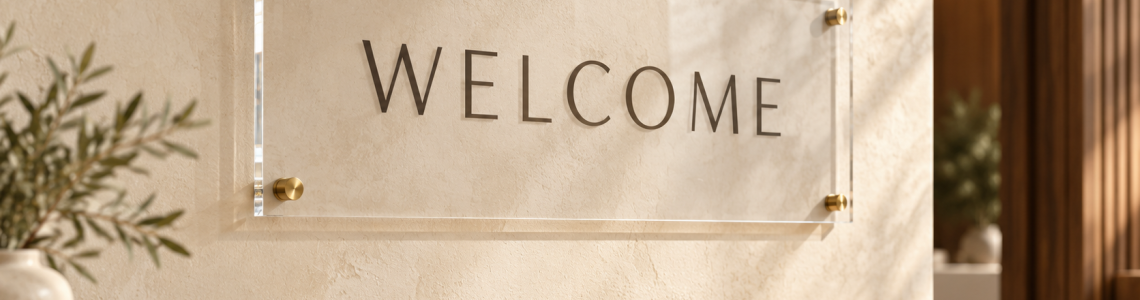
Standoff-mounted sign designs leave a visible separation between the panel and the wall. That spacing becomes part of the appearance, along with the attachment points themselves. Before choosing this approach, consider how those details fit your logo, room, and installation plan.
This is a buyer’s planning guide, not a set of structural mounting instructions. The correct attachment arrangement depends on the actual product and site, which need appropriate assessment.
Treat hardware as part of the composition
Visible attachment points can frame a panel, but they also occupy visual space. Ask to see their proposed relationship to the artwork. A logo pushed too close to a corner can feel crowded when the layout later includes hardware that was absent from the original mockup.
Review the complete panel rather than a cropped logo image. Confirm whether attachment positions are fixed or configurable for the product you are considering. Do not move holes or alter an approved design without discussing the consequences with the maker and installer.
Ask what is actually supplied
Product photographs may show a complete installation without specifying every included component. Request a written list of what comes with the selected order and what must be sourced separately. Confirm any available hardware appearance options directly rather than assuming a photographed finish is offered.
If components are included, ask for the relevant product information and installation guidance. Their presence in the package does not establish compatibility with every wall. Have the responsible installer assess the surface and determine what the site requires.
Consider the wall behind the panel
With a clear-panel concept, the wall remains visually involved. Its color, texture, seams, and shadows can all influence the composition. A small gap that looks subtle in an isolated product image may read differently beside a textured wall or directional light.
Supply actual room photos and ask how the proposed separation will be represented in the drawing. Screen previews are useful for understanding a concept but should not promise the exact reflections, transparency, or shadow pattern of the finished sign.
Review access and room activity
Consider where people stand, where furniture sits, and whether the proposed location is exposed to routine contact. Keep the display clear of features that need access. Raise any concern about the location with the installer rather than improvising an alternative attachment on the day.
Ask how the sign should be handled during installation and maintained afterward, using instructions for the actual supplied materials and finishes. Do not assume a general cleaning method applies to every printed surface, coating, or hardware treatment.
Confirm the complete drawing
The final design record should identify overall dimensions, artwork placement, and the attachment information relevant to the order. Compare it with the wall survey and approved location. Resolve conflicts before production instead of expecting the installer to adapt a finished panel to an unreviewed site.
Keep the hardware specification and installation guidance with the order documents. If the sign is moved or replaced later, that information will be more useful than a memory that it used “standard standoffs.” Each new location still deserves its own assessment.
Your planning checklist
- Review hardware alongside the artwork.
- Confirm the supplied component list.
- Obtain a site-specific wall assessment.
- Save the complete approved drawing and guidance.
Frequently asked questions
Are standoffs included with every acrylic sign?
Do not assume they are. Check the selected product and order specification for the exact supplied components and any separate requirements.
Can the same attachments be used on any wall?
That should be assessed for the actual wall and product. Ask the installer to confirm suitability rather than treating included components as universal.
Will a mockup show the exact shadow behind the panel?
No exact appearance should be assumed. Lighting, wall texture, spacing, and viewing position influence the result, and a digital illustration is only a planning aid.
Plan your next step
When considering the reception logo sign, ask which mounting configurations and components are currently available. Share the wall survey with your installer before confirming the installation plan.